MUZEOLÓGIA
MUSEOLOGY
a kultúrne dedičstvo
and Cultural Heritage

News
Journal Muzeológia a
kultúrne dedičstvo -
Museology and Cultural
Heritage:
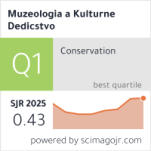
SJR 2025: 0,425 (Q1)
Museology SJR rank: 6/101 (Q1) Conservation SJR rank: 12/113 (Q1)JIF WoS 2025: 1,0
JCI WoS 2025: 1,22, Q1 ESCI: 33/403 (Q1)New issue
Muzeológia a kultúrne
dedičstvo 3/2026
online New volume Studia Museologica Slovaca, vol. 9 (2025) online New volume Populačné štúdie Slovenska 19 (2025) onlineNew book
L. Jagošová a P. Tišliar (eds.). Kapitoly z dějin uměleckoprůmyslového muzejnictví (2025) online
Contents 2/2026
Title: Visual Thinking Strategies in Museological Practice: Towards a Dialogical Model of
Interpretation
Abstract: This article examines the theoretical and practical implications of Visual Thinking Strategies (VTS) in contemporary
museological practice. Positioned against traditional models of curatorial authority, VTS introduces a dialogical and participatory
approach to interpretation based on collective visual inquiry. By encouraging open-ended observation and discussion, VTS reshapes
the relationship between visitors, objects, and institutional narratives. Drawing on international examples, the paper argues that VTS
reflects a broader shift in museology toward inclusivity, co-creation, and the decentralization of expert authority.
Authors: Grzegorz Schnotale1
Publication order reference:
1 Cracow University of Technology, Faculty of Architecture, Department of Drawing, Painting and Sculpture, Cracow, Poland, e-mail:
grzegorz.schnotale@pk.edu.pl, https://orcid.org/0000-0002-3183-8258
Source: Muzeológia a kultúrne dedičstvo, year: 2026, vol.: 14, issue: 2, pages: 5–14.
Keywords: Visual Thinking Strategies, museums, art-viewing behaviours, cultural heritage
Language: English
online full-text PDF
doi: 10.46284/mkd.2026.14.2.1
Title: Interpreting Intangible Cultural Heritage in Museum Practice: Krakow’s Centre as a Model of
Educational Innovation
Abstract: This article explores the role of the Intangible Cultural Heritage Interpretation Centre of Krakow (CINDK) as a model
institution for the protection, education and dissemination of intangible heritage in Poland. Established as a branch of the Historical
Museum of the City of Krakow, the Centre reflects contemporary museological trends by adopting participatory, inclusive and
interdisciplinary methods. It operates at the intersection of research, education and community engagement, emphasizing the co-
creation and living nature of heritage. The article presents the Centre’s key objectives and activities, including its documentation
projects, educational programs and cooperation with UNESCO. Special attention is given to flagship initiatives such as the Krakow
Nativity Scene and the Lajkonik procession, which are presented as successful cases of safeguarding local traditions within global
heritage frameworks. The analysis also identifies challenges – such as folklorisation, generational change, and the need for digital
innovation – and discusses how the Centre addresses them through educational outreach and international collaboration. The case of
Krakow illustrates how a local institution can function as a laboratory of heritage interpretation, connecting academic knowledge with
civic practice and contributing to the broader field of intangible heritage studies.
Authors: Justyna Łukaszewska-Haberkowa1
Publication order reference:
1 Independent researcher, Kraków, Poland, e-mail: justyna.haberkowa@gmail.com, https://orcid.org/0000-0003-0939-5566
Source: Muzeológia a kultúrne dedičstvo, year: 2026, vol.: 14, issue: 2, pages: 15–28.
Keywords: intangible cultural heritage, museum, tradition bearers
Language: English
online full-text PDF
doi: 10.46284/mkd.2026.14.2.2
Title: Museums as Catalysts for Sustainable Cultural Tourism: Insights from Hungary
Abstract: This article applies a four-pillar sustainability framework comprising cultural, environmental, social and economic
dimensions, to assess 46 museums in the less-developed Hungarian counties of Szabolcs–Szatmár–Bereg and
Borsod–Abaúj–Zemplén, thereby addressing a research gap, as previous studies have tended to focus on more developed regions.
The results show that half the institutions do not have formal sustainability strategies, but many are implementing practical initiatives.
Environmental actions are largely low-cost, while social and cultural contributions are strong, with museums acting as community
hubs, educators and custodians of heritage. Economically, museums support sustainability through local employment and
procurement. The study highlights museums’ under-recognised potential in sustainable tourism and calls for clearer strategies,
investment and professional training.
Author: Tekla Balogh Bodor1; Melinda Jászberényi2; Krisztina Keller3
Publication order reference:
1 Hungarian National Museum, Múzeum krt. 14–16, 1088 Budapest, Hungary & Corvinus University of Budapest 8 Fővám Square, 1093 Budapest, Hungary, e-
mail: tekla.balogh-bodor@stud.uni-corvinus.hu, https://orcid.org/0009-0009-4131-3824
2 Corvinus University of Budapest, Department of Tourism, 8 Fővám Square, 1093 Budapest, Hungary, e-mail: jaszberenyi@uni-corvinus.hu,
https://orcid.org/0000-0002-7839-5036
3 Corvinus University of Budapest, Department of Tourism, 8 Fővám Square, 1093 Budapest, Hungary, e-mail: krisztina.keller@uni-corvinus.hu,
https://orcid.org/0000-0002-4408-7940
Source: Muzeológia a kultúrne dedičstvo, year: 2026, vol.: 14, issue: 2, pages: 29–49.
Keywords: museums, sustainability, sustainable cultural tourism, four pillars
Language: English
online full-text PDF
doi: 10.46284/mkd.2026.14.2.3
Title: An ostrich egg depicting a scene of an enema, as an example of a curiosité and a manifestation
of a certain era
Abstract: This article presents an interdisciplinary analysis of a rare and intriguing artefact, a decorated ostrich egg held in the
Zamoyski Museum in Kozłówka, Poland, setting it within the tradition of curiosités and early modern European material culture. The
object, engraved with figural scenes, including a notably explicit depiction of an enema procedure, is interpreted through the lenses of
iconography, the history of medicine and the social conventions of seventeenth-century Dutch culture. The study explores how the
enema, beyond its medical function, operated as a metaphor for sexual desire, moral correction and corporeal control, reflecting the
period’s complex attitudes toward gender, the body and propriety. The egg is also considered in relation to the broader phenomenon of
luxury ostrich eggs as objets croisés – cross-cultural artefacts that blend exotic material origins with European craftsmanship and
emblematic content. Through visual and literary analysis, the article demonstrates how this single object embodies multilayered
narratives of curiosity, discipline, eroticism and social satire, while becoming a compelling testament to the symbolic richness and
ambiguity characteristic of early modern visual culture.
Authors: Małgorzata Żak-Kulesza1
Publication order reference:
1 The John Paul II Catholic University of Lublin, Department of Art History, Al. Racławickie 14, 20-950, Lublin; Poland e-mail: malzak@kul.pl,
https://orcid.org/0000-0002-3601-4709
Source: Muzeológia a kultúrne dedičstvo, year: 2026, vol.: 14, issue: 2, pages: 51–69.
Keywords: Dutch material culture, medical imagery in art, iconography, engraved ostrich eggs
Language: English
online full-text PDF
doi: 10.46284/mkd.2026.14.2.4
Title: Nikifor’s Work at the Krynica Zdrój Museum as an Example of Twentieth-Century Lemko Naive
Painting
Abstract: This article analyses the activities of the memorial museum of the self-taught artist Nikifor Krynica, whose real name is
Epifaniusz Drowniak. The museum’s uniqueness lies in its location in a historic wooden villa called Romanówka, which lends the
museum an authentic atmosphere.
The importance of Nikifor’s paintings lies not in the mastery of techniques or colour, but in their authenticity to the lands of his native
Lemko region. On the other hand, his sketches and watercolours provide insight into everyday life and society at different times; they
depict real architectural objects, some of which have not survived. In this case, the artist’s paintings become an important cultural,
historical, and restorative source of information.
Authors: Ion Sandu1; Krystyna Paprzyca2; Oleksandr Kashchenko3; Valerii Tovbych4
Publication order reference:
1 Аcademy of Romanian Scientists AOSR, Аlexandru Ioan Cuza University of Iasi, Interdisciplinary Research Institute – Science Department, National Institute
for Research and Development in Environmental Protection, Romanian Inventors Forum, Rumunia, e-mail: ion.sandu@uaic.ro, https://orcid.org/0000-0003-
4088-8967
2 Academy of Silesia, Faculty of Architecture, Civil Engineering and Applied Arts, Katowice, Poland, e-mail: kpaprzyca@gmail.com, https://orcid.org/0000-0003-
0112-1456
3 Kyiv National University of Construction and Architecture, Ukraine, e-mail: kashchenko.ov@knuba.edu.ua, https://orcid.org/0000-0001-8570-264X
4 Kyiv National University of Construction and Architecture, Ukraine; e-mail: tovbych@gmail.com, https://orcid.org/0000-0002-4794-4944
Source: Muzeológia a kultúrne dedičstvo, year: 2026, vol.: 14, issue: 2, pages: 71–81.
Keywords: Nikifor Krynicki, Krynica Zdrój, Lemko culture, self-taught artist, naive painting
Language: English
online full-text PDF
doi: 10.46284/mkd.2026.14.2.5
Articles (Abstracts)
Full-text version
DOI:10.46284/mkd.2026.14.2.0
ISSN 1339-2204
eISSN 2453-9759
EV 1/22/EPP
Vol. 14 (2026), No. Is. 2
Published: 1.6.2026